SmartChef or SmartTrace? Which Food Safety System Does Your Business Need?
Published on: October 25, 2026
By Mark Long, co-founder of SmartChef and Managing Director of Food Safety Management Solutions Ltd (25+ years in food safety and HACCP compliance)
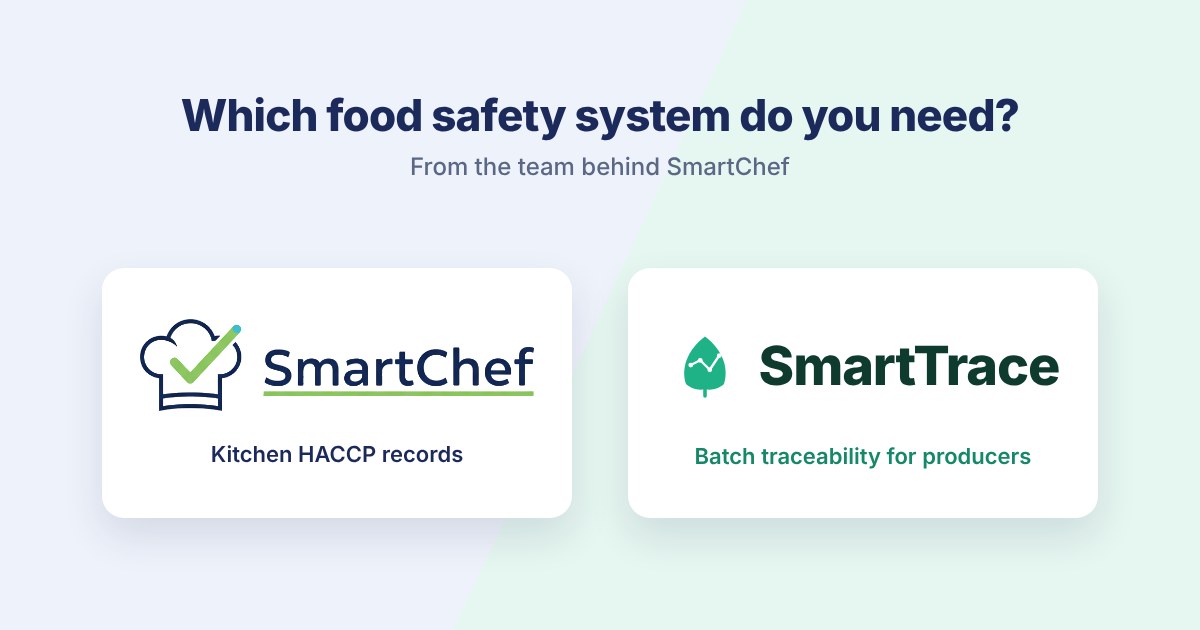
Since we launched SmartChef, one question keeps coming from bakers, cheesemakers, chutney makers and growers: "Does SmartChef do traceability?" The honest answer is that it does what a kitchen needs. A food producer needs something different, so we built it. It's called SmartTrace.
This article explains the difference between the two: what each one does, who each one suits, and how to tell which one your business needs. They're separate products because they do separate jobs, and most businesses fit clearly into one or the other.
Key takeaways
- SmartChef is for businesses that cook and serve food to the public. It keeps your daily HACCP records: temperatures, deliveries, cooking, cooling, hot holding and cleaning.
- SmartTrace is for businesses that make food in batches that's sold on. It records which ingredients went into which batch, and which customers received it.
- One answers "was the food handled safely?" The other answers "where did it come from and where did it go?"
1. Two different jobs in food safety
Food safety law in Ireland asks two separate things of a food business, and it helps to keep them apart in your head.
HACCP records show that food was handled safely. EU Regulation 852/2004 requires every food business to run a food safety management system based on HACCP principles, and to keep records that prove it's working. In a kitchen, that means fridge and freezer temperatures, delivery checks, cooking and cooling temperatures, hot holding, probe checks and cleaning. This is what an Environmental Health Officer looks at during an inspection.
Traceability records show where food came from and where it went. Article 18 of EU Regulation 178/2002 requires every food business to know who supplied it, and which businesses it supplied. This is usually called "one step back, one step forward". Sales to the final consumer don't need to be recorded, which is why a café doesn't keep a list of who ate which scone.
For a kitchen, the traceability part is light. You need to know your suppliers and the batch codes on what arrived, and that's covered by good delivery records. For a producer selling to shops, cafés and distributors, traceability is the heart of the job. And the part that matters most during a recall is the link in the middle: which ingredient deliveries went into which batch. Without that link, a problem with one sack of flour can mean recalling everything you made that month. With it, you recall one or two batches and ring a handful of customers.
2. SmartChef: HACCP records for kitchens
SmartChef replaces the paper HACCP folder in a working kitchen. Staff record checks on their own phones or a shared tablet, under their own name, with the time recorded automatically.
Who it's for: cafés, restaurants, pubs, hotels, nursing homes, food trucks, delis and caterers.
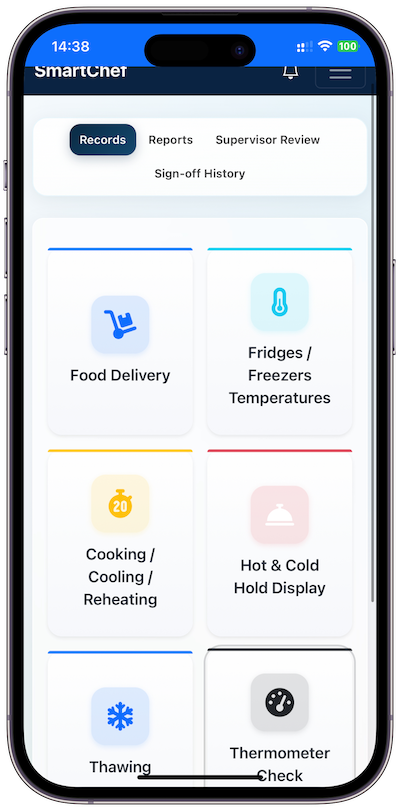
What it records:
- Deliveries, by taking a photo of the label. SmartChef reads the supplier, batch code and use by date.
- Fridge, freezer and equipment temperatures.
- Cooking, cooling and reheating, hot and cold holding, and probe checks.
- Cleaning schedules and transport.
It reminds staff when checks are due, works in several languages, and offers optional 24/7 WiFi temperature monitoring for fridges and freezers. See the full list of HACCP records SmartChef covers.
The moment it earns its keep: the EHO walks in, asks for last month's fridge temperatures, and you show them on your phone.
3. SmartTrace: batch traceability for food producers
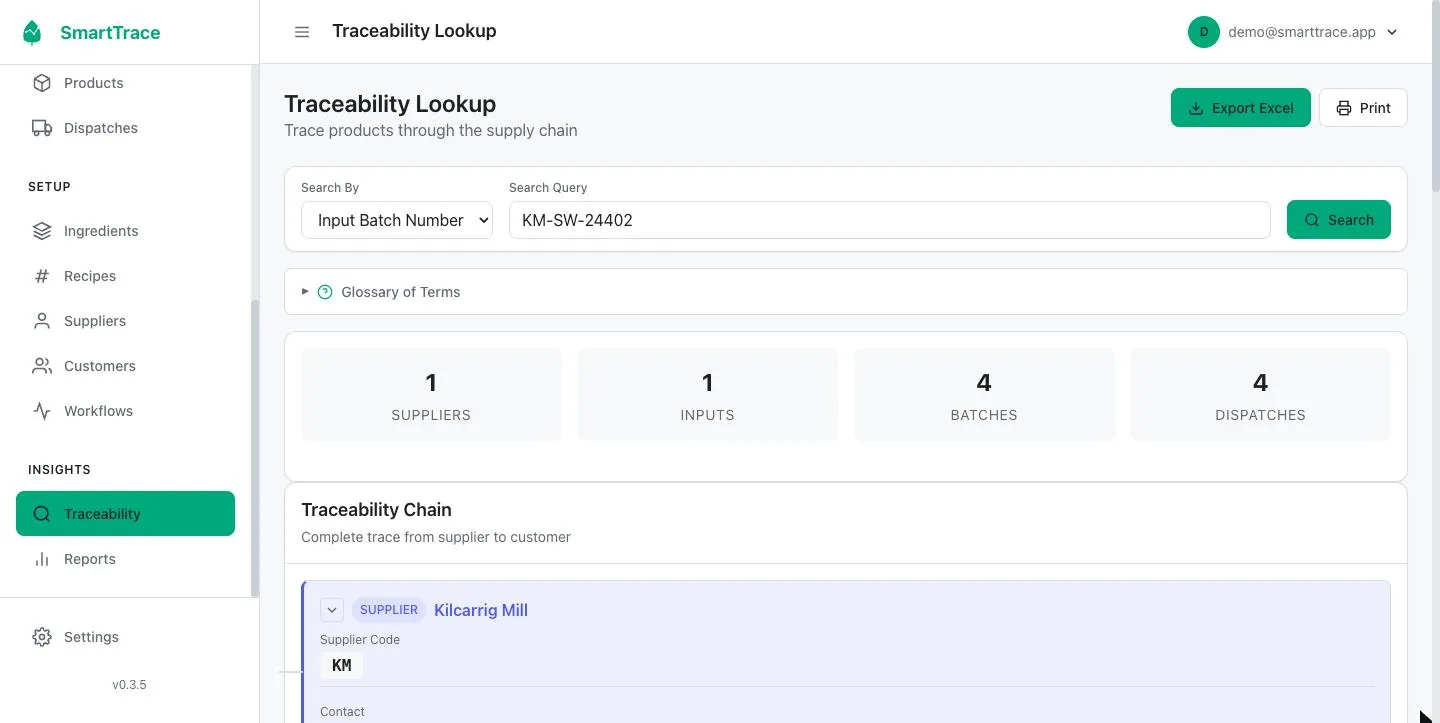
SmartTrace follows your food from the supplier's delivery, through your batches, to the customer you sold it to. It's built for small producers who make food in batches and sell it on, and who currently keep their traceability in a notebook, a spreadsheet or their head.
Who it's for: bakeries supplying shops and cafés, cheese and dairy producers, butchers and charcuterie makers, makers of preserves, sauces and chutneys, ready meal producers, microgreens and salad growers, chocolatiers, coffee roasters and other small producers.
What it records:
- Ingredient deliveries with the supplier's lot number. Take a photo of the label and SmartTrace reads it.
- Your recipes, and every batch you make from them, with exactly which deliveries went in.
- Dispatches: which batches went to which customer, and when.
Every ingredient delivery and every batch can have its own QR label. Stick one on the sack of flour when it arrives, and when you start a batch you scan the sack instead of picking it from a list. If you want labels printed on the spot, SmartTrace works with the Phomemo M221, a small Bluetooth label printer that costs about €60 to €70. It's optional, and it's the only hardware you'd ever need.
The moment it earns its keep: a supplier rings to say a lot of flour has been recalled. You type in the lot number and SmartTrace gives you the full report in seconds: which batches used it and which customers received them. See how SmartTrace works.
4. SmartChef and SmartTrace side by side
| SmartChef | SmartTrace | |
|---|---|---|
| The question it answers | Was the food handled safely? | Where did it come from and where did it go? |
| Typical business | Cafés, restaurants, pubs, hotels, nursing homes, food trucks | Bakeries, cheesemakers, butchers, preserve makers, growers and other small producers |
| What you record | Temperatures, deliveries, cooking, cooling, hot holding, cleaning | Ingredient deliveries, batches, dispatches to customers |
| When it pays off | An EHO inspection | A recall, a supplier problem or a customer audit |
| Who uses it | Kitchen staff, on phones or a shared tablet | The production team on phones, the office on a computer |
| Optional hardware | WiFi temperature sensors, Bluetooth probe | A Bluetooth label printer, about €60 to €70 |
| Price | From €25 a month | €25 a month, one plan |
| Contract | None, 30 day money back guarantee | None, 30 day money back guarantee |
5. Which one is right for your business?
Go by what you do most days, not by what your business is called.
SmartChef fits if…
- You cook or prepare food and serve it to the public
- An EHO inspects your kitchen and asks for temperature and cleaning records
- Your customers are the people eating the food
SmartTrace fits if…
- You make food in batches
- You sell to shops, cafés, markets, distributors or online
- Buyers ask you for lot numbers or traceability
- A recall would mean ringing your customers
A farm shop with a café counter is running a kitchen, so it's a SmartChef business. A farm business whose main work is making jams and chutneys for other people's shelves is a producer, so it's a SmartTrace business. If you're not sure where you fall, ring us on 087 180 7873 or 086 272 6347, or email hello@smartchef.ie. We'll tell you honestly which one fits.
6. Why are they separate products?
Because they do different jobs. SmartChef is built around a day in a kitchen: the checks that are due, the temperatures, and the records an EHO will ask to see. SmartTrace is built around production: ingredient lots coming in, batches being made, product going out to customers, and a report that links them all together. The screens, the records and the reports are different because the work is different.
The people using them are doing different jobs too. A chef doing the 7am fridge check wants it finished in a few taps and wants nothing on the screen that isn't about the kitchen. A producer starting a batch wants to scan the ingredients going into it and print a label for what comes out. Squeezing both into one app would make each of them slower and more confusing.
Keeping them separate keeps each one simple for the people who use it every day, and keeps the price at a level a small business can actually justify.
7. Built by people who know food safety
SmartChef and SmartTrace are both made by SmartChef Ltd, an Irish company. I've spent more than 25 years in food safety and HACCP compliance, working with hundreds of kitchens and food businesses across Ireland. My co-founder, Warren Harding, has more than 30 years in technology and operations. SmartChef is used every day in kitchens across Ireland, and SmartTrace has been built alongside small Irish producers who have been using it in pilot.
Neither product is affiliated with, endorsed by or approved by the Food Safety Authority of Ireland. Both are built to capture the information Irish and EU food law asks for, in a form that's easier to keep up with than paper.
8. Getting started
SmartChef
Try the interactive demo, or sign up from €25 a month. Setup and training are included, there's no contract, and there's a 30 day money back guarantee.
SmartTrace
Sign up and we'll ring you within one working day to set up your recipes, suppliers and customers with you, free. Then you have 7 days to try it before paying €25 a month. No contract, 30 day money back guarantee.
FAQ: SmartChef, SmartTrace and Food Traceability
1. What's the difference between SmartChef and SmartTrace?
SmartChef keeps the daily HACCP records a kitchen needs, such as temperatures, deliveries, cooking, cooling, hot holding and cleaning. SmartTrace keeps the traceability records a food producer needs: which supplier deliveries went into which batch, and which customers received it. SmartChef answers "was the food handled safely?" and SmartTrace answers "where did it come from and where did it go?"
2. Does SmartChef do traceability?
Yes, the traceability a kitchen or caterer needs. SmartChef records incoming deliveries with supplier and batch code, and caterers can link cooking batch codes to deliveries out to customers. What it isn't built for is production traceability: recipes, ingredient lots allocated to every batch, and a full report from any lot number across all your customers. That's what SmartTrace does.
3. Is traceability part of HACCP?
They're related but separate legal requirements. HACCP, under EU Regulation 852/2004, is about identifying and controlling food safety hazards. Traceability, under Article 18 of EU Regulation 178/2002, is about being able to say where food came from and where it went. A good HACCP system relies on traceability when something goes wrong, because that's how you find the affected product.
4. Do small food producers in Ireland need traceability records?
Yes. Article 18 of EU Regulation 178/2002 applies to every food business, whatever its size. You must be able to identify who supplied your ingredients and which businesses you supplied. Many retailers and wholesale buyers also ask for lot numbers and traceability as a condition of stocking your product.
5. What does "one step back, one step forward" mean?
It's the basic traceability rule. One step back means knowing who supplied each ingredient or product you received. One step forward means knowing which businesses you supplied. Sales direct to the final consumer don't need to be recorded. For a producer, the link in the middle, which deliveries went into which batch, is what keeps a recall small.
6. How do I know which one my business needs?
Go by what you do most days. If you cook or prepare food and serve it to the public, and an EHO inspects your kitchen records, SmartChef is the fit. If you make food in batches that's sold on through shops, cafés, markets or distributors, SmartTrace is the fit. If you're not sure, ring us on 087 180 7873 or 086 272 6347, or email hello@smartchef.ie, and we'll tell you honestly.
7. Why are SmartChef and SmartTrace separate products?
Because they do different jobs. SmartChef is built around the daily checks and records of a kitchen. SmartTrace is built around production: ingredient lots in, batches made and product out to customers. The people using them are doing different jobs too. A chef doing the 7am fridge check wants it done in a few taps. A producer wants to scan a sack of flour into a batch. Putting both into one app would make each of them slower and more confusing, so each product stays simple for the people using it.
8. How much do SmartChef and SmartTrace cost?
SmartChef costs from €25 a month. SmartTrace costs €25 a month with one plan that includes unlimited users and batches. Neither has a contract, and both come with a 30 day money back guarantee.
9. Do I need any special equipment?
No. Both run on the phones, tablets and computers you already have. SmartChef offers optional WiFi temperature sensors for 24/7 fridge monitoring. SmartTrace works with an optional Bluetooth label printer, the Phomemo M221, which costs about €60 to €70 and prints through a free Android app.
10. How quickly can SmartTrace find where a batch went?
In seconds. Type in a supplier lot number or one of your own batch numbers and SmartTrace gives you the full report: which deliveries went into it, which batches used it, and which customers received it and when.
11. Who makes SmartTrace?
SmartTrace is a food traceability app from SmartChef Ltd, an Irish company. It's built by the same team behind SmartChef, the digital HACCP system used in kitchens across Ireland.
Related Articles
Delivery Records for Outbound Food
How kitchens and caterers record deliveries to customers with batch codes in SmartChef.
Food Traceability Explained (SmartTrace guide)
A simple guide to traceability for small food producers in Ireland.